Thursday, September 20, 2012

Montessori Compass and Current Issues in Montessori Education


As some of my readers may know, I am currently working on a Master of Arts degree through the AM2 program at St. Catherine University.  In my course, Analysis of Contemporary Issues in Montessori Education, an interesting topic surfaced during one of our discussions.  We had been talking about challenges in Montessori education, specifically educating the public about our programs as well as our struggle to constantly debunk common misconceptions of the method.  One of my cohorts brought up another important issue - record keeping.  Imagine my delight to be able share with the group my experience with Montessori Compass and how it has addressed the very issues being discussed:

This is the second year I have been using Montessori Compass as my main record keeping system. Interestingly, I have found that using this online resource has addressed the other two issues being discussed: public education of Montessori and common misconceptions. I have seen firsthand the effect such an information sharing tool has had in my school community. Firstly, parents of my students have a direct link to the activities in which their children are participating at school including detailed information of the direct and indirect aims of a given lesson. This is a brilliant way to educate parents - and it takes no extra time (other than the time to customize the curriculum, input information, observations, etc.) This "window" into their child's day is much appreciated and met with enthusiasm. Overtime, trends can be seen and parents come to the realization of all that happens in a Montessori setting which paves the way for fewer misconceptions of the method.


Thank you, Montessori Compass for providing Montessori educators a platform to raise awareness and promote the philosophy in such an easily accessible manner.


Tuesday, September 18, 2012

Land and Water Flat Map

Last summer, I discovered a wonderful blog The Helpful Garden, where I found the map for the following lesson.  We have been exploring the elements of Earth during these first days of school and one of the lessons I recently presented the children is a simple coloring activity.  Most of the children in the class are new to Montessori, and wanting to promote the process and cycle of activity, I chose to keep the lesson very simple.

The materials on the shelf:  Color version of the Land and Water Flat Map, wooden tray with small vase for a pencil,  a brown crayon, and a blue crayon, basket with maps to color.
To complete the lesson, a student brings the small vase and a map to a table making sure to place a newspaper under their work space.  I always have the children use newspapers for two reasons - one, it helps to protect our tables, and two, it aids in defining the child's workspace.

Here, the child has successfully set up the materials and is completing the lesson.
Afterwards, all materials are placed back in their original spots on the shelf, ready for use by another child.

Land and Water Flat Maps in our hallway.

Saturday, September 15, 2012

Small Steps...

...toward a greater goal - something I have reminded myself each day this week!  We are working hard to establish a safe and calm environment in which the children may thrive.  From the very first day of school, we have been promoting independence in the simple things - pouring a drink of water for oneself, turning on the water faucet, and learning to make decisions in self-directed activities.  We've dried many tears at drop-off, helped to clean up numerous spills, and lots of materials have ended up on the floor, but progress is already evident!  Mats are being rolled up, chairs are being pushed in, and perhaps most importantly, our Gratitude Jar is in active use.  Here are some snippets of classroom happenings this week (not very many, I'm afraid, due to the events mentioned above!).

Matching continents with the first parts of the Three Part Cards.

One of the Kindergarteners made the Maze with the Red Rods.

Science:  Magnetic/Non-magnetic work.

Opening and Closing practice.

Basic pouring.

Red Rods initial lesson.

A second year student had all four Cylinder Blocks out - a wonderful lesson to promote concentration!
Learning to thread a needle.

Vocabulary Enrichment cards - Types of Birds.

Handwashing Lesson.

Practical Life:  Polishing Leather

Learning to fold with the Folding Cloths.

Cursive writing practice which turned into...

...this!  The student has circled and numbered her favorite three letters, something she decided to do on her own.    I very much appreciate this as analyzing one's own work is an importance step in the learning process.

September calendar work.

Washing the Easel, a wonderful Practical Life lesson which promotes concentration and establishes a sense of pride in the child's environment.

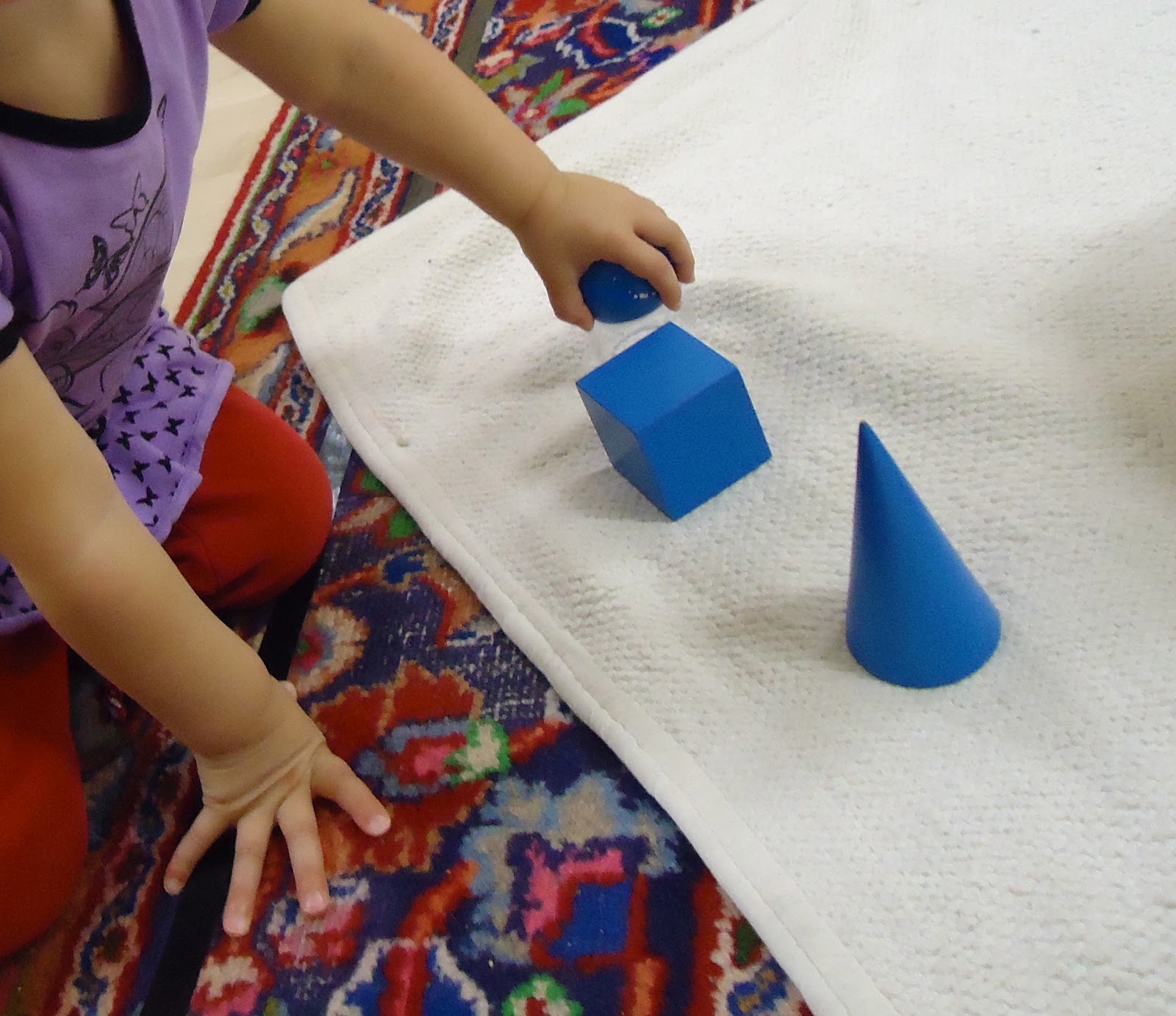
Learning about form and shape with the Geometric Solids.

Math lesson with the Cards and Counters.

Wednesday, September 12, 2012

Montessori 101


If you are new to Montessori and would like to know more about Theory and Philosophy, please be sure to read my posts under Theory or Montessori labels in the sidebar.  The beginning of the school year is an ideal time to revisit these concepts as well - if you are  a parent of of one of my students, you will want to read these!  I also wanted to share an informative post from Living Montessori Now about Isolation of Quality.  Please click HERE to learn about this important aspect in understanding the design of Montessori materials.  You'll even see a picture from our classroom while you're there - Enjoy! 

Saturday, September 8, 2012

Here We Go!

Wow, we are back into the full swing of things around here!  Our classroom came alive with many new sets of hands working with materials for the very first time.  We are also so fortunate to have a wonderful core group of returning students who have amazed me with their recall and memory of classroom procedures.  Here is a glimpse of life in our classroom during the first few days of school:


Working with the Solid Cylinders.

Practical Life skills:  Button Frame

Practical Life:  Spooning lesson

Learning how to fold with the Folding Cloths.
Pre-reading:  Colors and Matching

Practical Life:  Pouring Water (with no handles).

Practical Life:  Sponging

The Geo Board - very popular!

Another favorite - the Magnet Board.

Making a collage with the gluing lesson.

A basic Paper Cutting lesson.
Bears in a Line

Chalk Pastels

Setting a Table

The Hundred Chain - a wonderful representation of the full age range in our class this year.

Sensorial work with the Red Rods.

Pin pushing collage.
Brown Stair exploration.

Tuesday, September 4, 2012

Bears in a Line


The following activity is one which I plan to show before lining up to go outside.  I thought it would be appealing to the children with the vibrant colors and of course, the adorable teddy bears.  Giving the students this visual of how to line up will surely help some of our newest members of the class!  Once, I show the children the activity, I plan to leave it on a shelf so that they may practice lining up the bears as well - great fine motor practice while encouraging group cooperation as we walk down the halls on our way outside!

The material on a tray:  small container with a length of ribbon; bowl with 18 bears (the same number of children in the class on each day).  
Bears in a line!
It will be interesting to observe if the children begin making color patterns - something I plan not to show them, but rather leave open for self-discovery.

Wednesday, August 29, 2012

Pipe Cleaner Sculptures

This week my Assistants and I have spent lots of time in the classroom reviewing lessons, looking over materials and getting things ready for our 'School Visit' morning.  This is a block of time for enrolled children to come in and get a sense of the classroom.  They find their cubbies, hooks, work bins, the restroom, and other components of their new environment.  During this time, I also set up some traditional play materials such as blocks, trains, and markers for coloring so that the children may identify with familiar materials.  One activity I thought would be exciting for the children to complete is a pipe cleaner sculpture.  This, I thought, would be something simple and fun which the children may take home with them after their visit.  Hopefully by bringing their sculpture home, they can continue dialogue about school with their families and keep the excitement going!


My assistants assembled the activity using remnants from the art closet - this is a wonderful way to use up extra beads or pipe cleaners you may have!  We thought setting it up at a large table would be ideal during the 'School Visit' morning where three to four children may be working together.  A large container holds a batch of play dough - a small piece of this will form the base of the child's sculpture.  A divided tray holds an assortment of colorful beads with many interesting textures.  The eye catching Turkish vase is the perfect place for an array of pipe cleaners.

Beads and pipe cleaners for sculptures.
After placing the pipe cleaners into the play dough base, the child may explore shape and dimension while bending the wires into the desired position.  Meanwhile, they can also thread their choice of beads onto the pipe cleaners to create one-of- kind, multi-dimensional sculptures!

Bending...

...and twisting...

Pipe cleaner sculpture!
We also set up a stack of parchment paper squares on which to place their sculpture and to write the child's name with a Sharpie marker.  It is our plan to have this activity available during the first days of school as well.

So fun and cheerful - just what we want the kids to feel!


Montessori Monday Link-Up

Montessori Monday